
InsightsAlphaFarm2026-08-03 · 4 min read
Non-Power Revenue Model for Biogas Plants — Bio-CO₂ AlphaFarm
Bio-CO₂ AlphaFarm connects waste heat, Bio-CO₂, recovered water, and idle land from biogas power plants with premium strawberry production, creating additional non-power revenue and ESG value.
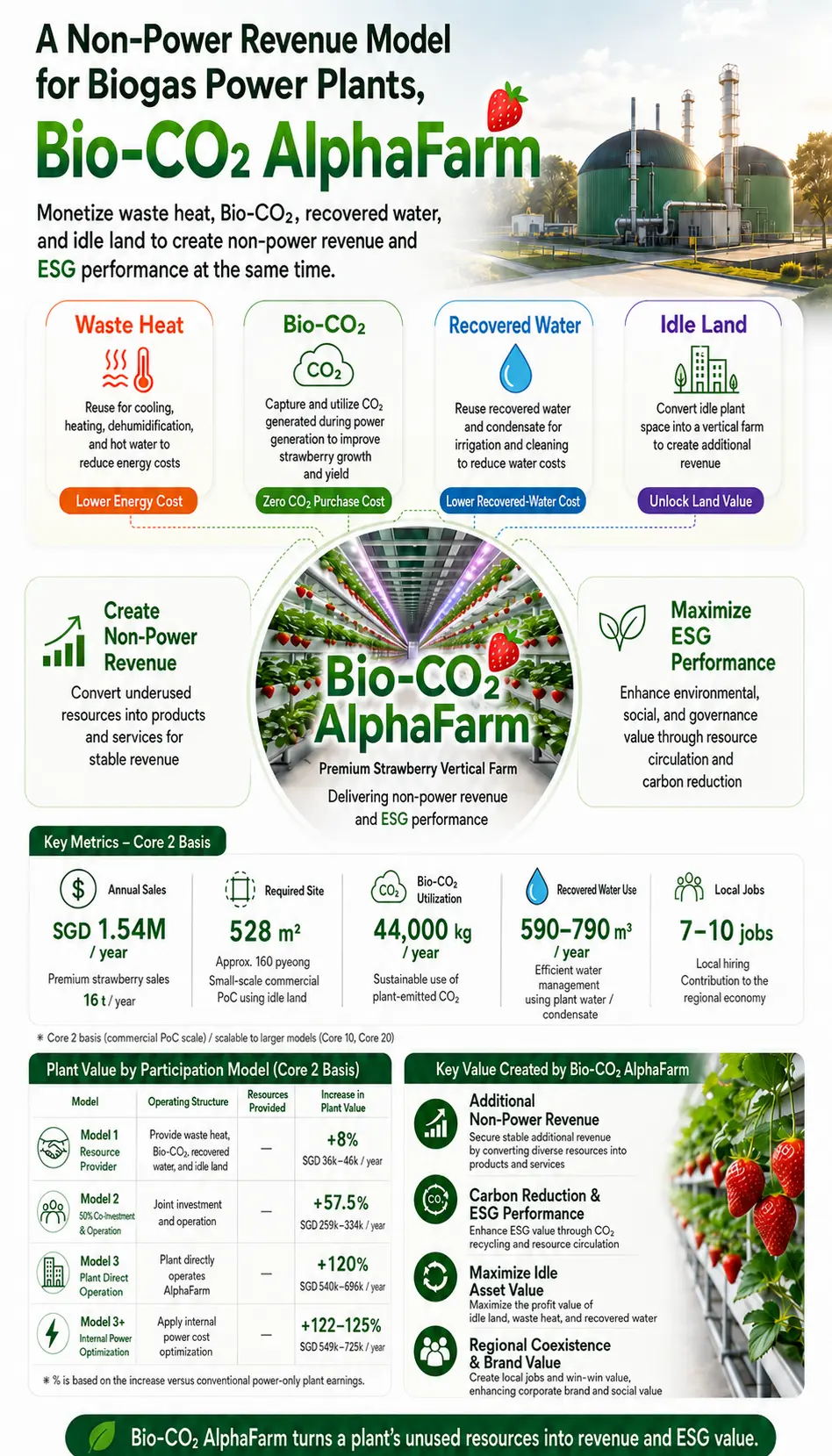
Adding a New Revenue Layer to Electricity Sales
Biogas power plants can maintain their existing power-generation business while adding new value to resources and land already available on-site. Bio-CO₂ AlphaFarm connects energy production with premium food production at the same location.
Turning Four Site Resources into Productive Inputs
Each resource is connected to AlphaFarm's cultivation and energy systems after its quality and availability conditions are reviewed.
- Waste heat — used for supplementary reheat, heating, recovered-water preheating, or cooling support where site conditions are suitable
- Bio-CO₂ — replaces purchased cultivation CO₂ after source analysis, purification, quality and safety validation, and controlled dosing
- Recovered water — used for irrigation or farm utilities following water-quality verification and any required treatment
- Idle land or buildings — converted into a premium strawberry production and expansion base
Value for Plant Operators
- Monetisation of underutilised resources and higher site value
- ESG performance through carbon utilisation, circularity, and local employment
- A new business linked to premium agriculture and local food markets
- Replication and scale-up opportunities supported by operating PoC data
Phased Application Based on Site Conditions
The project is configured as Core 1, Core 2, or a larger model after reviewing CO₂ quality and availability, waste-heat grade and operating hours, recovered-water quality, site area, power, and utilities.
The initial PoC verifies resource substitution, farm performance, strawberry quality, energy effects, and ESG indicators to establish the basis for scale-up.
Frequently asked questions
Q. What site data is needed for the initial review?
We review biogas generation capacity and operating hours, CO₂ quality and availability, waste-heat temperature and availability, recovered-water quality and volume, idle land or building area, and power, water, and drainage conditions.
Q. Can Bio-CO₂ be supplied directly to cultivation?
The CO₂ source is analysed, purified, and validated for quality and safety before controlled dosing to cultivation. The required treatment configuration depends on the power-generation system and the CO₂ recovery point.
Q. How can recovered water be used?
Following water-quality verification and any required treatment, recovered water can be used for irrigation or farm utilities such as cleaning and cooling. Its final use is determined by source quality and applicable site standards.
Turn power-plant waste and idle resources into new revenue and ESG value.
Share your CO₂ source, waste heat, recovered water, idle-site, and operating conditions, and we will review a suitable Bio-CO₂ AlphaFarm scale and phased PoC structure.
Related Keywords
- Bio-CO₂ AlphaFarm
- Biogas Power Plant
- Non-Power Revenue
- Recovered-Water Utilization
- Idle-Land Utilization
- Resource Circularity
Related insights
- Bio-CO₂ AlphaFarm CO₂ Supply Pathway Comparison — Exhaust-Gas Catalytic Post-Treatment vs Upgrade-Linked Purification
- Bio-CO₂ AlphaFarm — Connecting Biogas By-products with Steady Farm Demand
- What Is DSRP? Year-Round Strawberry Production through Multi-Layer Flowering-Seedling Nurseries and Rotational Plant Replacement
Learn more about the AlphaFarm premium strawberry vertical farm — production, cooling, and cold-chain platform by CESeL Primus.
← Back to Insights