
InsightsAlphaFarm2026-07-28 · 5 min read
Bio-CO₂ AlphaFarm CO₂ Supply Pathway Comparison — Exhaust-Gas Catalytic Post-Treatment vs Upgrade-Linked Purification
When waste heat and CO₂ from biogas power generation become farm resources, CO₂ can be supplied in two main ways. The exhaust-gas catalytic post-treatment route and the upgrade-linked CO₂ purification route are chosen by site conditions and project scale.
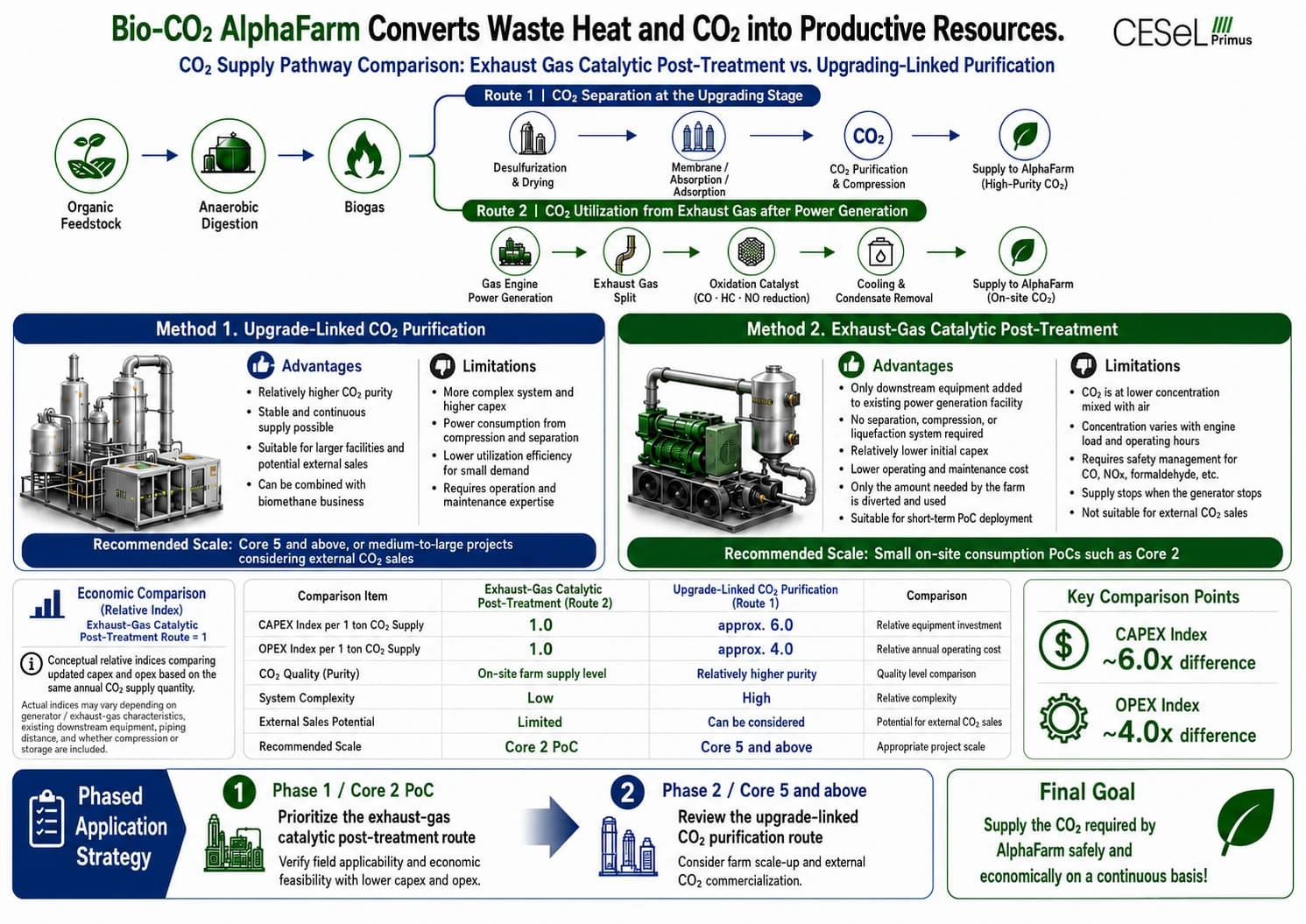
Two CO₂ Supply Pathways
Biogas from the anaerobic digestion of organic feedstock can yield CO₂ at two different points, depending on where it is recovered.
Route 1 separates and purifies CO₂ during the biogas upgrading (biomethane) stage and supplies high-purity CO₂. Route 2 diverts only the amount needed from the exhaust gas after gas-engine power generation, treats it with a catalyst, and uses it on-site.
- Route 1 (separation at the upgrading stage) — organic feedstock → anaerobic digestion → biogas → desulfurization & drying → membrane/absorption/adsorption → CO₂ purification & compression → supply to AlphaFarm (high-purity)
- Route 2 (utilization from exhaust gas after power generation) — gas-engine power generation → exhaust-gas split → oxidation catalyst (CO·HC·NO reduction) → cooling & condensate removal → supply to AlphaFarm (on-site CO₂)
Method 1. Upgrade-Linked CO₂ Purification
Linked to the process that purifies biogas into biomethane, this method purifies and compresses the separated CO₂. It secures relatively high purity on a stable basis, suiting medium-to-large projects and potential external sales.
- Advantages — relatively higher CO₂ purity, stable and continuous supply, suitable for larger facilities and potential external sales, can be combined with a biomethane business
- Limitations — more complex system and higher capex, power consumption from separation and compression, lower utilization efficiency at small scale, requires operation and maintenance expertise
- Recommended scale — Core 5 and above, or medium-to-large projects considering external CO₂ sales
Method 2. Exhaust-Gas Catalytic Post-Treatment
Adding only downstream equipment to existing power generation, this method treats part of the exhaust gas with a catalyst and uses only what the farm needs. Its low initial capex and operating burden suit small on-site consumption PoCs.
- Advantages — only downstream equipment added to existing generation, no separation/compression/liquefaction required, relatively lower initial capex, lower operating and maintenance cost, only the amount needed by the farm is diverted, suitable for short-term PoC deployment
- Limitations — CO₂ at lower concentration mixed with air, concentration varies with engine load and operating hours, requires safety management for CO, NOₓ, formaldehyde, etc., supply stops when the generator stops, not suitable for precise control
- Recommended scale — small on-site consumption PoCs such as Core 2
Economic Comparison (Relative Index)
With exhaust-gas catalytic post-treatment set to 1.0, these are conceptual relative indices comparing both methods for the same annual CO₂ supply quantity. The upgrade-linked purification method shows higher capex and opex because it adds separation, compression, and purification equipment.
※ These are conceptual relative indices. Actual values vary with generator and exhaust-gas characteristics, existing downstream equipment, piping distance, and whether compression or storage are included, so they are estimated separately for each site.
- CAPEX index per 1 ton CO₂ supplied — exhaust-gas post-treatment 1.0 vs upgrade-linked purification ≈ 6.0 (~6× difference)
- OPEX index per 1 ton CO₂ supplied — exhaust-gas post-treatment 1.0 vs upgrade-linked purification ≈ 4.0 (~4× difference)
- CO₂ quality (purity) — exhaust-gas post-treatment: on-site farm supply level / upgrade-linked purification: relatively higher purity
- System complexity — exhaust-gas post-treatment: low / upgrade-linked purification: high
- External sales potential — exhaust-gas post-treatment: limited / upgrade-linked purification: can be considered
- Recommended scale — exhaust-gas post-treatment: Core 2 PoC / upgrade-linked purification: Core 5 and above
Phased Application Strategy
We recommend a two-phase approach that first confirms field applicability and economics, then scales up.
- Phase 1 · Core 2 PoC — prioritize the exhaust-gas catalytic post-treatment route, verifying field applicability and economic feasibility with lower capex and opex.
- Phase 2 · Core 5 and above — review the upgrade-linked CO₂ purification route, together with farm scale-up and external CO₂ commercialization.
- Final goal — supply the CO₂ required by AlphaFarm safely and economically on a continuous basis
Frequently asked questions
Q. Which method should be introduced first?
In the early stage, we recommend building a Core 2-scale PoC with the exhaust-gas catalytic post-treatment method, which has lower capex and opex, to verify field applicability and economics. The upgrade-linked CO₂ purification method is then introduced as the farm scales up or external CO₂ sales are considered.
Q. Are the ~6× capex and ~4× opex differences fixed values?
No. They are conceptual relative indices comparing both methods for the same annual CO₂ supply quantity, with exhaust-gas post-treatment set to 1.0. Actual values vary with generator and exhaust-gas characteristics, existing downstream equipment, piping distance, and whether compression or storage are included, so they are estimated separately for each site.
Q. Is the exhaust-gas method safe?
Exhaust gas can contain CO, NOₓ, and formaldehyde, so it is reduced with an oxidation catalyst and passed through cooling and condensate removal before use, with concentration monitoring and safety management. Where precise concentration control is required, the upgrade-linked purification method is more suitable.
We'll design a CO₂ supply pathway that fits your biogas resources.
Tell us your generation scale and exhaust-gas or biogas conditions, and we'll review a CO₂ supply method and phased PoC plan for Bio-CO₂ AlphaFarm and reply directly.
Related Keywords
- Bio-CO₂ AlphaFarm
- Biogas CO₂
- Exhaust-Gas Catalytic Post-Treatment
- Upgrade-Linked Purification
- CO₂ Utilization
- Strawberry Vertical Farm
Related insights
Learn more about the AlphaFarm premium strawberry vertical farm — production, cooling, and cold-chain platform by CESeL Primus.
← Back to Insights