
InsightsAlphaFarm2026-07-18 · 4 min read
Bio AlphaFarm — Connecting Biogas By-products with Steady Farm Demand
Connecting a biogas plant's surplus CO₂ and waste heat with AlphaFarm's steady demand.
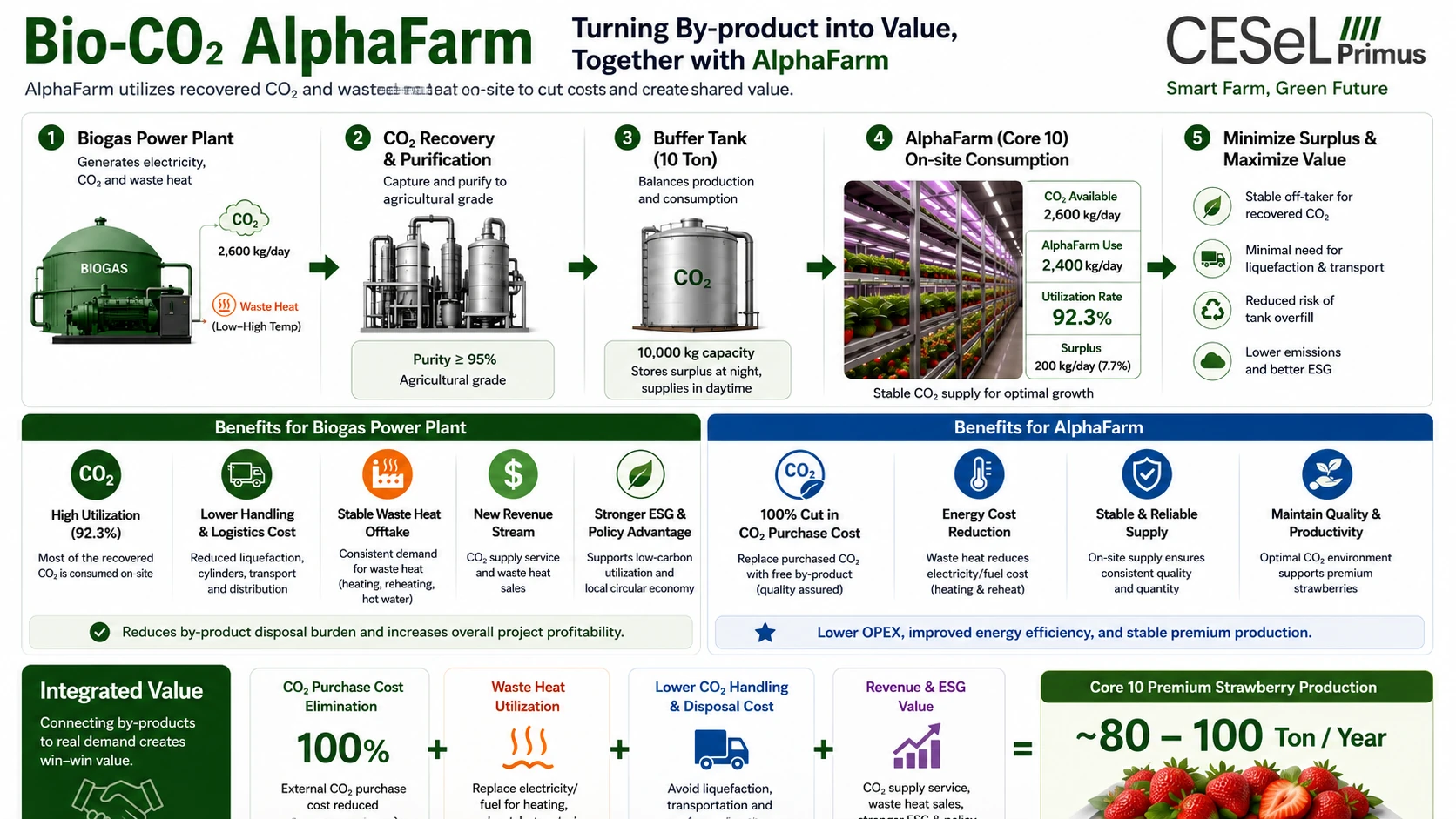
Connecting Biogas CO₂ and Waste Heat with AlphaFarm Demand
CO₂ from biogas power generation is recovered and purified, while a buffer tank balances continuous plant output with daytime farm consumption.
The biogas plant secures a stable on-site off-taker for recovered CO₂ and waste heat, reducing dependence on liquefaction, filling, transport, and separate surplus-resource handling. AlphaFarm replaces purchased cultivation CO₂ and uses waste heat for supplementary reheat, heating, and water preheating, helping lower operating costs.
Illustrative Figures (Core 10 Basis)
On an illustrative Core 10 basis (Core 1 × 10), AlphaFarm uses 2,400kg/day of 2,600kg/day purified CO₂ on-site, achieving 92.3% utilization and limiting surplus CO₂ to 200kg/day (7.7%). This can replace 876 tons/year of external CO₂ purchases. On a free-supply basis, the illustrative purchase-cost replacement is approximately SGD 263,000/year, using KRW 1,000 = SGD 1. Purification, piping, blower, and control costs remain separate.
Waste-heat use of 3,500kWhₜₕ/day and premium strawberry production of approximately 80–100 tons/year indicate project scale, not a yield-increase claim from CO₂ supply.
※ 92.3%, 876 tons/year, 3,500kWhₜₕ/day, and 80–100 tons/year are illustrative figures. Actual results vary with biogas composition, CO₂ recovery rate, heat grade, farm scale, and operating hours.
- 2,400kg/day of 2,600kg/day purified CO₂ used on-site — 92.3% utilization
- Surplus CO₂ limited to 200kg/day (7.7%)
- Replaces 876 tons/year of external CO₂ purchases
- Illustrative purchase-cost replacement ≈ SGD 263,000/year (free-supply basis)
- 3,500kWhₜₕ/day waste-heat use
- Core 10 premium strawberry production ≈ 80–100 tons/year (project-scale example)
Key Benefits
- Biogas power plant — stable on-site CO₂ off-taker, lower dependence on liquefaction and transport, reduced buffer-overflow and venting risk, and steady waste-heat demand
- AlphaFarm — replacement of external CO₂ purchases, stable CO₂ supply, and lower reheat, heating, and preheating energy costs
- Integrated project — a circular business model that reduces the plant's surplus-resource burden and the farm's operating cost at the same time