
PROJECT 07 · 2026-10-31
Rethinking Vertical Farming: Beyond Crop Selection, Toward Business Model and Production System Redesign
Moving from leafy greens to premium strawberries was a response to intensifying competition and limited differentiation. Yet changing the crop portfolio did not, by itself, resolve the underlying business challenges.
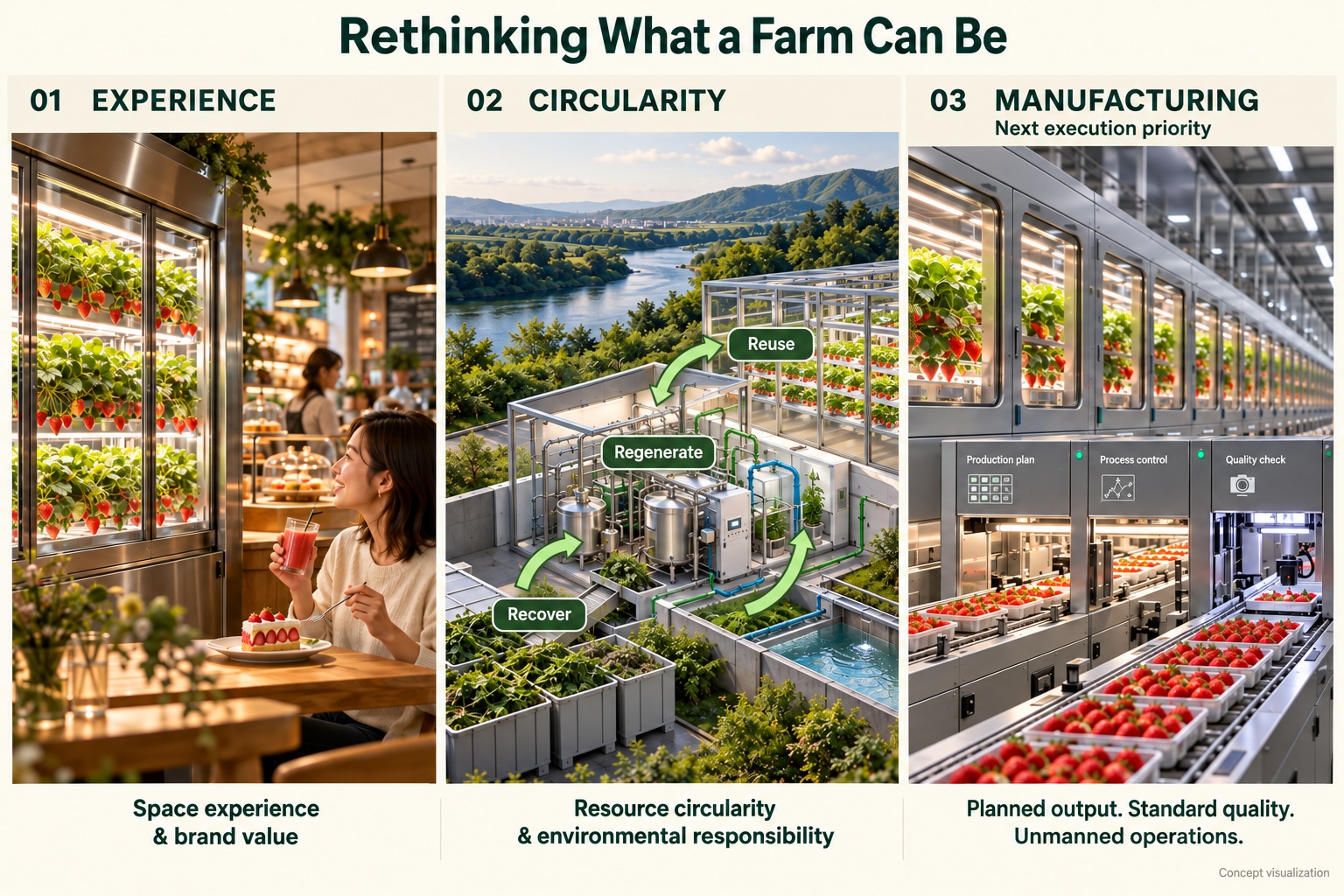
Concept visualization · Not a photograph of an installed facility
A substantial gap remained between the value the market needed and the value being offered.
Vertical farming requires significant CAPEX and recurring OPEX. Can premium pricing support that cost structure? Can the investment still deliver an acceptable return when yields fall short of plan?
Customers also have established alternatives. In Korea, seasonal greenhouse production, highland cultivation and imports form part of the competitive landscape. In Singapore, imported strawberries offer multiple sourcing options. The advantages of year-round and local production still need to translate into purchasing decisions and willingness to pay.
Automation and AI bring a similar challenge. Unless reliability and economics are demonstrated, operators carry both the adoption cost and the consequences of production disruption.
These experiences have shaped three directions for business development.
① AIO Grower — Extending Value into Space and Brand Experience
The AIO Grower brings year-round strawberry cultivation into urban cafés, hotels and restaurants.
Cultivation becomes part of interior design, menus, displays and customer engagement. Its business case therefore includes space utilization, customer experience and brand differentiation alongside production economics.
The task is to define a meaningful role for cultivation within each setting—and a clear reason to invest in it.
② Bio AlphaFarm — Environmental and Economic Sustainability through Resource Circularity
Bio AlphaFarm connects the recovery, conversion and reuse of underutilized resources and by-products with productive cultivation.
An important purpose is to reduce waste, demand for new resources and the environmental burden of production. Operating cost savings provide an economic foundation that allows this circular model to endure.
Performance needs to be assessed on both dimensions: resource recovery and reuse, displacement of external inputs and waste reduction, together with net operating savings after processing infrastructure and maintenance costs.
The direction is a transition from resource consumption and disposal toward a production model built around circulation and reuse.
③ Manufacturing-Based Production — Planned Output, Standard Quality and Unmanned Operations
The next execution priority is to redesign production from a manufacturing perspective: define target output and quality standards first, then build the entire process around unmanned operation.
Seedling specifications, growth-stage processes, internal handling, harvesting and quality inspection become one integrated system. With appropriate investment and integration across disciplines, this direction can be pursued using today’s technology base.
Execution depends on effective process integration and the scale at which economic viability can be achieved. Biological variability and exceptions need to be incorporated into the design, with performance evaluated against planned output, quality consistency, uptime and unit cost.
This is a business development priority to advance through investment and practical validation.
Each direction addresses a different question:
AIO Grower: What new value can cultivation create for a space and its customers?
Bio AlphaFarm: How can resources circulate while reducing environmental impact and operating costs?
Manufacturing-Based Production: How can planned output and standard quality be delivered without continuous human intervention?
The next competitive advantage in vertical farming will take shape through the combined design of customer value, resource use and repeatable production.